
 Dharmendra Kumar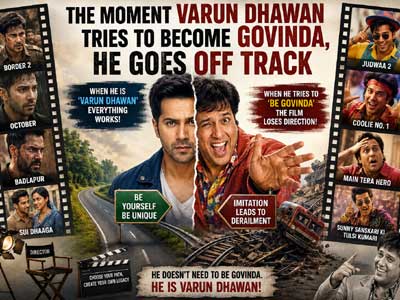
Why does Varun Dhawan try to become 'Govinda'? The question is interesting because if we look closely at Varun Dhawan’s career, the answer seems to lie not in his acting ability, but in his choice of acting style.
Varun Dhawan has energy, screen presence, a natural flair for dancing, the confidence to do comedy, and, when required, the ability to prove himself in serious roles. When he uses these strengths in his own style, he grows as an actor. But whenever he tries to “capture” Govinda’s mannerisms, gestures, dialogue delivery and comic body language, his own identity often gets pushed far into the background.
Read in Hindi: ‘गोविंदा’ बनते ही पटरी से उतर जाते हैं वरुण धवन
That is perhaps the biggest contradiction of Varun Dhawan’s career. When he is “Varun Dhawan,” he looks better; but when he starts trying to “become Govinda,” he begins to look artificial.
He made his debut with ‘Student of the Year’. As ‘Rohan Nanda’, he represented the image of the new, glamorous and urban Bollywood hero of that time. The film did not demand much from him as an actor, but the confidence and physical energy within Varun were clearly visible. He did not look like a copy of any older actor. That was important because his own screen personality was present right from the beginning.
In ‘Main Tera Hero’, he appeared to be moving towards the kind of path that would later be described as Govinda-style comedy. Rapid-fire dialogues, a mischievous hero, physical comedy, a character chasing girls and exaggerated reactions to every situation naturally brought Govinda’s films to mind. But there was a difference: Varun’s energy was his own. The problem begins when he turns that energy into a near-exact imitation of Govinda.
With ‘Humpty Sharma Ki Dulhania’, Varun took a different route. ‘Humpty’ was neither Govinda, nor Salman Khan, nor Shah Rukh Khan. He was a carefree, friendly and emotional Punjabi boy. Varun’s naturalness became his strength here.
Then came ‘Badlapur’, and Varun delivered perhaps the most important performance of his career. As ‘Raghav’, he showed that he was not merely an actor capable of dancing, comedy and romance. The way he portrayed the fire of revenge, guilt, violence and psychological breakdown inside an otherwise ordinary-looking man broke the limited perception people had formed about him. There was no shadow of Govinda here. This was simply Varun. And this quality became even more pronounced in ‘October’.
‘October’ is perhaps the strongest evidence in this entire debate. As ‘Danish Walia’, Varun almost pushed his star persona aside. The character’s silence, restlessness, emotional confusion and ability to make the audience feel without saying much showed that Varun had serious potential as an actor. The film is not important because Varun performed some exceptionally difficult emotional scenes; it is important because he controlled his usual playful screen personality. Instead of merely “performing,” he tried to inhabit the character.
That is why, while watching Varun in films such as ‘October’ and the later ‘Border 2’, one wonders why he repeatedly feels the need to “become Govinda.” In ‘Border 2’, his character, ‘Major Hoshiar Singh Dahiya’, brings out another side of him, one in which he relies more on the character than on his own star persona. The positive response to his performance also suggests that audiences do not want to see him merely as a comedy hero.
But when the Varun seen between ‘Humpty Sharma Ki Dulhania’ and ‘Badlapur’ arrived in ‘Dilwale’, the picture changed again. There, he became part of a larger romantic-action universe dominated by Shah Rukh Khan. In ‘Dishoom’, his style was that of a buddy action-comedy hero. In ‘Baby John’, another attempt to establish himself as an action star was visible. In ‘Badrinath Ki Dulhania’, he once again used his natural comic energy. In these films, he was not imitating any particular actor; he was building his own star image.
Then came ‘Judwaa 2’. This is where the comparison with Govinda becomes particularly sharp, although technically the film was a remake of Salman Khan’s Judwaa. Yet Varun’s comic performance repeatedly evoked memories of 1990s Govinda. In the dual roles of ‘Raja’ and ‘Prem’, he had to create two distinct personalities, but in many places his performance seemed to lose out to the characters themselves. Salman Khan had his own ‘star’ personality in the original ‘Judwaa’; in Varun’s version, it often seemed as though he was trying to bring the language of 1990s comedy back to the screen today.
Ironically, the commercial success of ‘Judwaa 2’ may have sent Varun the wrong message. Perhaps he felt that audiences were enjoying this particular style of his. An actor has to understand the difference between applause at the box office and the full extent of his acting ability.
After ‘October’, the character of ‘Mauji’ in ‘Sui Dhaaga’ once again brought out a different Varun Dhawan. A struggling young man from a small town, trying to build a business with his wife, is not a character that can be created by imitating a star. Here, Varun’s body language was different, his voice was different, and most importantly, he did not allow his looks and star persona to overpower the character.
In ‘Kalank’, he played ‘Zafar’, but the film’s grandeur and weak story did not give his performance enough room to breathe. In ‘Street Dancer 3D’, he returned as a dancing star. Dance is Varun’s own strength, and he does not need to imitate Govinda for that. Govinda was a great dancer, but his physical language was completely different from Varun Dhawan’s.
And then came ‘Coolie No. 1’. Here, a comparison with Govinda was almost unavoidable because the film itself was a remake of the 1995 Govinda-David Dhawan film. In the original, everything about Govinda’s comic timing, from the movement of his facial muscles to the variations in his voice, was part of his personality. The problem for Varun was that he did not merely have to repeat the same story; he had to reinvent the character in his own language.
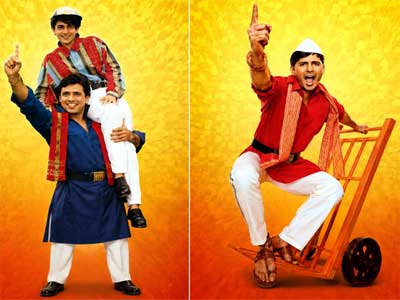
But at several points in the film, it seemed as though he was trying to recreate Govinda’s energy, whereas Govinda’s greatest strength was precisely that he never recreated somebody else’s energy. He created his own. That is why it is easy to dismiss the failure of ‘Coolie No. 1’ simply as a ‘bad remake’, but in the context of Varun’s career, it points to a larger problem.
In ‘JugJugg Jeeyo’, Varun returned to his natural space. The character of ‘Kuku’ neither demanded that he become Govinda nor imitate an old superstar. A young man caught in the complications of a troubled marriage was a more natural territory for him. In ‘Bhediya’, he took yet another direction, balancing physical comedy, horror-comedy and emotion. In ‘Bawaal’, he once again attempted a different kind of character.
In ‘Sunny Sanskari Ki Tulsi Kumari’, the same old problem surfaced again. The character demanded a romantic-comic hero with playfulness, exaggerated reactions and the influence of old Hindi cinema. Varun brought his natural energy to the role.
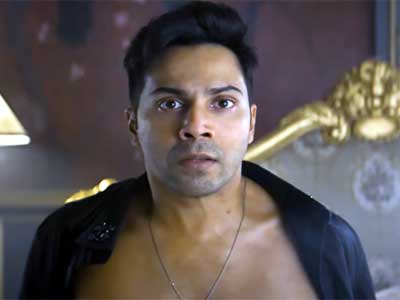
This is where another comparison with Govinda becomes necessary. It would be unfair to understand Govinda merely through the dialogues, dance or facial expressions in his films. Govinda’s greatest quality was that he absorbed comedy into his personality. Even while acting, he never appeared to be thinking, “Now I am doing comedy.” His body, voice, eyes, pauses and dialogue delivery all worked together. Varun has tremendous energy, but at times that energy is not controlled and begins to go to waste. The difference is small, but for an actor, that small difference is enormous.
Another great strength of Govinda was his ‘timing’. He could change the meaning of a scene by delivering a dialogue one second earlier or one second later. Varun’s comic acting sometimes announces the punchline in advance. The audience can sense that a joke is coming. With Govinda, the joke often seemed to emerge spontaneously from within him. That is why imitating Govinda is almost impossible for any actor. You can copy his walk, imitate his voice and reproduce his dance, but you cannot steal his timing.
Interestingly, Govinda himself was never confined to a single formula. His comedy in films such as ‘Aankhen’, ‘Raja Babu’, ‘Coolie No. 1’, ‘Saajan Chale Sasural’, ‘Hero No. 1’, ‘Bade Miyan Chote Miyan’ and ‘Dulhe Raja’ was not identical from film to film. His partnership with David Dhawan created a distinct language of 1990s Hindi comedy, combining mistaken identities, rapid-fire dialogue, slapstick and romance.
Varun’s problem is that he sometimes tries to become the ‘heir’ to that language, when he should be creating a language of his own. This is where examples such as ‘Border 2’ and ‘October’ become particularly important. When Varun steps out of the shadow of another actor in these films, his face looks different. He appears more serious, more credible and like a bigger actor.
If we look at Varun Dhawan’s entire filmography together, the picture becomes clear. In ‘Student of the Year’, he established his own face. In ‘Main Tera Hero’, he discovered his comic energy. In ‘Humpty Sharma Ki Dulhania’, he strengthened his romantic identity. In ‘Badlapur’ and ‘October’, he revealed his potential as an actor. In ‘ABCD 2’, ‘Dishoom’, ‘Badrinath Ki Dulhania’ and ‘Street Dancer 3D’, he used his commercial strengths. In ‘Sui Dhaaga’, ‘JugJugg Jeeyo’, ‘Bhediya’ and ‘Bawaal’, he explored different shades. But in films such as ‘Judwaa 2’ and ‘Coolie No. 1’, whenever he tried to revive established images associated with older stars, his own personality became weaker. This pattern is clearly visible in his filmography.
The comparison between Govinda and Varun is interesting because the two share several similarities. Both are good dancers. Both can do comedy. Both possess tremendous physical energy. Both can combine romance with humour. Both have strong screen presence. But their biggest difference is that Govinda created his own style, whereas Varun sometimes wears a style that has already been created. And perhaps that is what Varun needs to understand.
Varun Dhawan does not need to become ‘Govinda’. He cannot become ‘Govinda’, nor should he try to. Govinda was ‘Govinda’ in his era. Varun is ‘Varun Dhawan’ in his era. He has his own physicality, his own fingerprint, his own iris, his own voice, his own innocence, his own humour and his own ability to play serious characters. When he uses these qualities, he becomes extremely appealing. When he tries to imitate Govinda’s walk, dialogues and mannerisms, the audience sees not his acting but the “effort” behind it.
The experience of ‘Sunny Sanskari Ki Tulsi Kumari’ is important for precisely this reason. Varun’s own energy repeatedly appears to hold the film together. The problem is not the energy; the problem is the direction in which that energy is being used.
The best thing for Varun is that he does not need to borrow someone else’s name to prove his ability. In ‘Badlapur’, ‘October’, ‘Sui Dhaaga’, ‘JugJugg Jeeyo’, ‘Bhediya’ and ‘Border 2’, he appeared to belong to his characters. Taken together, these films reveal a fine actor with far greater possibilities than simply being a comedian.
So the real question is not, “Why does Varun Dhawan act like Govinda?” The real question is, “When Varun Dhawan can be so good as himself, why does he need to become Govinda?”
By wearing Govinda’s cloak, Varun may remind audiences of Govinda. But by being Varun Dhawan, he can leave audiences remembering Varun Dhawan. And what greater success can there be for an actor than for audiences to walk out of a theatre not saying, “That was like Govinda,” but rather, “Only Varun Dhawan could have done that”? He only needs to understand one thing: the best way to honour a legacy is not by imitation, but by creating an identity of your own.
Related Items
Not just a ‘Star', Dharmendra was a ‘Legacy’...
Decision-making style at home hinders women in workplace
More financial institutions worldwide acting on climate