
 Brij Khandelwal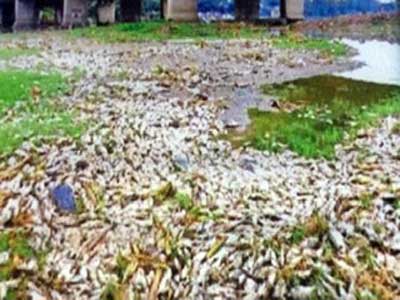
As thousands of dead fish floated in the Yamuna, people living along the banks and a large number of pilgrims were shocked. The stink and the deadly sight made people sick. It’s a clear alarm signal about the health of the river, warned river activists.
The dead fish were first spotted near the Jawahar bridge, close to Balkeshwar Ghat, in the Agra region, said Pandit Jugal Kishore of the River Connect Campaign.
Eminent environmentalist Devashish Bhattacharya who visited the sites said that the dead fish had been discharged from the Gokul barrage in Mathura. The river water stocked in the Gokul barrage is depleted with Oxygen and is highly toxic, as drains upstream continue to discharge toxic industrial effluents along with sewer. The state government agencies have no plans to tackle this problem, Bhattacharya added.
The Yamuna river is virtually dry after the Okhla barrage in Delhi. “What flows down in the name of water is sewage and industrial waste. The river is totally unfit to support any type of aqua life,” said Jagan Nath Poddar, convener of the Friends of Vrindavan Society.
State Pollution Control Board officials in Agra said the dead fish found in Agra, was an alarm signal. The water quality is extremely poor.
River activists in Agra are incensed by repeated attempts to fell trees along the Yamuna banks in Agra to lay a pipeline. Devashish Bhattacharya has already filed a petition in the Supreme Court against the district authorities for failing to check the chopping of trees in the eco-sensitive zone close to the Taj Mahal and the Agra Fort.
In Mathura and Vrindavan, activists are mobilizing support to launch an agitation to free the Yamuna flood plains of encroachments. Sunil Sharma, an activist said dozens of drains are opening into the river discharging untreated waste. “All along the banks of the river several organizations have grabbed chunks of land and construction work continues unabated,” Sharma added. The river has been distanced away from the ancient ghats, as illegal mining of sand has been going on for a long time.
In Agra, the state pollution control board has listed 90 odd drains still discharging waste and sewer into the river. The municipal corporation claims it has already tapped 40 odd drains. “But the ground reality is quite different, as any survey of the sites will prove,” says green activist Ranjan Sharma.
After thousands of fish were found dead in the Yamuna in Mathura and Vrindavan on Friday and Saturday, devotees and pilgrims blamed official agencies for failing to keep the river clean.
Lakhs of devotees visit Mathura and Goverdhan and Yamuna, said to be the sister of Yamraj, the Hindu god of death, on Guru Poornima.
"As I entered the water for a holy dip, I was put off by the stink of rotting fish all around," said a pilgrim from Gujarat, Pradeep Bhai.
An Uttar Pradesh Pollution Control Board official in Mathura said that untreated wastewater and industrial effluents had been discharged upstream, resulting in the deaths of fish due to oxygen depletion.
Activists blamed the Okhla Barrage authorities for releasing untreated water without advance notice.
The Yamuna is the lifeline of Braj Mandal and sustains tourism in the Agra region.
"All historical buildings are located along Yamuna's banks. If the Yamuna is sick and polluted, the architectural marvels like the Taj Mahal cannot remain unaffected," said Ranjan Sharma, an environmentalist.
Related Items
Yamuna carries sewage, Government watches in silence
10 countries, 17 destinations and one Yamuna in the heart…
Why are people drowning in the Yamuna...!