
 Brij Khandelwal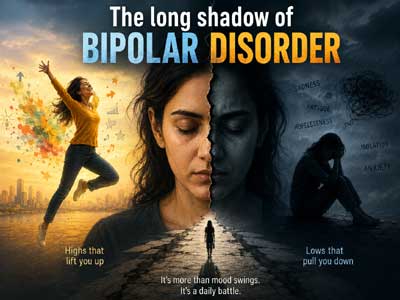
What happens when the mind becomes both a battlefield and a prison?
For Santosh Nayar, a Chartered Accountant who lived across continents, the answer was painfully complicated. He experienced extraordinary highs and devastating lows while battling bipolar disorder. His autobiography, Silver Linings in the Dark Sky, written with striking honesty during his incarceration, looks beyond the diagnosis to the man struggling to understand himself.
Nayar died on 4 May 2024. His manuscript survived him. Nearly a decade after it was preserved, it has finally appeared as a book, edited by Dr Alok Gupta.
Gupta says, "It is not merely a story about mental illness. It is about loneliness, damaged relationships, mistakes, dignity, survival and the stubborn possibility of hope. That is why Nayar’s story matters."
Bipolar disorder is casually described as ‘mood swings’. The phrase makes a serious illness sound like ordinary bad temper. It is anything but that.
Everyone has good days and bad days. Bipolar disorder involves distinct episodes of mania or hypomania and crushing depression. During mania, sleep may feel unnecessary, thoughts race, confidence soars, and risk-taking can feel completely rational. Money may disappear. Relationships may fracture.
Decisions made in hours can create consequences lasting years. In severe episodes, delusions or hallucinations may occur.
Depression can be equally devastating. Energy disappears. Pleasure fades. Even simple tasks become mountains. A person may feel hopeless, worthless or unable to imagine a future.
The cruellest part is that during mania the person may not feel ill at all. According to Prof Paras Nath Choudhary, "Families therefore often see behaviour before they see illness. They may mistake mania for arrogance, depression for laziness or impaired judgement for irresponsibility. Understanding the illness does not mean excusing every action. It means recognising that behaviour can sometimes have a medical explanation."
Rapper and music producer Yo Yo Honey Singh offers another powerful example. At the height of his career, he seemed unstoppable, then vanished from public life. Singh has spoken openly about bipolar disorder with psychotic symptoms and the long period during which he struggled to function. Some patients also describe the difficulty of finding treatment that works and the role of substance use in worsening problems. Often, success does not make the brain immune to illness. Money cannot guarantee mental health. Fame cannot buy emotional stability. A packed concert cannot protect someone from a psychiatric disorder.
Actress Shama Sikander has also spoken publicly about bipolar disorder and depression. Her experience highlights another problem: mental illness does not always arrive dramatically. Sometimes it begins quietly, with disturbed sleep, exhaustion, withdrawal or a persistent loss of interest. People wait. They blame work, relationships, age, stress or themselves. Meanwhile, the illness continues its work in the shadows.
The death of actor Sushant Singh Rajput brought bipolar disorder into millions of Indian homes. Reports about his treatment and diagnosis triggered widespread discussion about depression, anxiety, medication and psychiatric care. Psychiatrists who saw him reported a bipolar diagnosis among other concerns; accounts differ on the precise picture.
Bipolar disorder does not automatically lead to suicide or tragedy. Millions of people live productive, meaningful lives with appropriate treatment. Turning one person’s death into a simplistic lesson about bipolar disorder can deepen, rather than reduce, misunderstanding. What the episode did reveal was the urgent need to treat mental illness with the same seriousness we give physical illness.
Experts say India has a treatment problem. The numbers are sobering. India’s National Mental Health Survey (2015–16) found a lifetime prevalence of bipolar affective disorder of about 0.5 per cent and a current prevalence of about 0.3 per cent. Given India’s population, that still means millions of people. The treatment gap for current bipolar disorder stood at roughly 70 per cent. Other estimates, including Global Burden of Disease figures, have placed the number living with bipolar disorder in India in the several millions.
Behind every percentage is a human being. Someone may spend years moving between doctors. Another family may first turn to faith healers. Unusual behaviour may be blamed on possession, planets, bad luck or weak character.
Stigma makes the journey harder. Words like “mad,” “pagal” and “psycho” are casually used as jokes or insults. For someone already struggling, such language can become another locked door between suffering and treatment.
Bipolar disorder has biological roots, but biology does not tell the whole story. Genes, brain chemistry, sleep disruption, stress, alcohol and drugs, and other social factors can interact in complicated ways. The human brain is not a motivational poster. “Think positive” is not a treatment plan. “Control yourself” is not psychiatric care.
The hopeful truth is that bipolar disorder is treatable. Treatment may involve mood-stabilising medicines, antipsychotic medication when needed, psychotherapy, and family or social support. Finding the right combination can take time. Medicines may need adjustment. Relapses can happen. None of that means treatment has failed.
Regular psychiatric care, adequate sleep, avoiding substance misuse, and a supportive environment can make a profound difference. Recovery may not mean eliminating every difficult day. It can mean regaining control, rebuilding relationships and returning to work and ordinary life.
That is perhaps the most important lesson in Nayar’s story. A diagnosis should explain a condition. It should never become a person’s identity.
Santosh Nayar was not simply a bipolar patient. He was a professional, traveller, writer, friend and human being who made mistakes and endured consequences while trying to live with an unpredictable mind. His manuscript survived because he left behind more than a medical history. He left a testimony.
Bipolar disorder is not possession. It is not punishment. It is not a moral failure. And it is certainly not another word for madness. It is an illness that deserves diagnosis, treatment, patience and dignity.
Perhaps the first silver lining in any dark sky is simple: someone finally understands what the darkness is.
Related Items
AI tools are reinforcing eating disorder behaviours!
Mood-boosting methods as proven by science
Sleeping Sickness Not Just A Sleeping Disorder…