
 Brij Khandelwal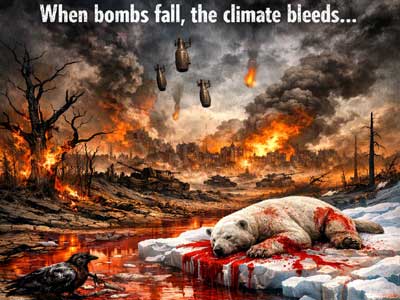
For them, war was just a game. They came. The skies exploded with deadly fireworks. Bombs fell. Missiles flew. Drones swarmed. Thousands died. Homes were reduced to rubble. The air turned toxic. Temperatures rose. Oceans warmed. Forests burned and vanished. Then they left. But the monsoon lost its rhythm. Now, the rest of us must live with the consequences.
The monsoon is India's heartbeat. It fills our rivers, nourishes our fields, replenishes our aquifers and sustains millions of livelihoods. Yet, that heartbeat seems increasingly irregular.
This year, the month of March witnessed an unusually high number of Western Disturbances. Around eight such systems swept across northern India, compared with the normal five to six. Rain arrived out of season. Hail battered crops. Temperatures fluctuated wildly. The march towards summer stumbled.
The pattern continued through April, May and early June. Meteorologists caution against linking any single weather event to climate change. But they agree on one unsettling reality: human activities are altering the atmosphere, disturbing long-established weather patterns and making extreme events more frequent. The question we must ask is simple. How much more disruption can nature absorb?
For decades, environmentalists have warned about fossil fuels, deforestation and industrial pollution. Yet one major polluter often escapes scrutiny: war. Every missile launched, every fighter jet deployed, every tank mobilised and every city reduced to rubble leaves behind a massive carbon footprint. Military operations consume staggering amounts of fuel. Explosions release toxic chemicals. Burning infrastructure injects soot and greenhouse gases into the atmosphere. Reconstruction demands enormous quantities of cement, steel and energy. War does not merely kill people. It poisons rivers, scars forests, contaminates soil and destabilises the climate.
The environmental cost of conflict extends far beyond national borders. Smoke respects no passport. Carbon emissions need no visa. Atmospheric pollution drifts across continents.
While no scientific evidence links any specific conflict or military offensive directly to disruptions in the Indian monsoon, it would be equally irresponsible to ignore the cumulative impact of warfare on a planet already running a fever.
Climate change is not caused by one nation, one army or one battle. It is the sum of countless human actions, including the machinery of war. And yet, military emissions remain one of the least regulated aspects of global climate policy.
Why are nations required to disclose industrial emissions but not the full environmental costs of armed conflict? Why do climate summits discuss carbon budgets while wars burn through them without accountability?
The world urgently needs a new principle: environmental accountability during war. Military emissions should be measured, reported and independently verified. The destruction of ecosystems during conflicts should be recognised as an assault on humanity's shared natural heritage. Environmental damage caused by war must become part of international negotiations on climate justice. Peace is not merely a political aspiration. It is an ecological necessity.
The Indian monsoon depends on a delicate choreography of oceans, winds, mountains and temperatures. Frequent Western Disturbances, warming seas and shifting jet streams remind us that this balance is fragile.
When we wage war against each other, we also wage war against the Earth. And the atmosphere keeps the score. If we truly wish to protect our monsoon, our farmers and our future, we must expand our understanding of security. National security cannot be separated from ecological security.
A world at war cannot build a stable climate. The next great peace movement must also be green.
Related Items
Wealthy protect themselves from climate risks, leaving poor vulnerable
India’s vanishing repair culture and the toxic rise of e-waste
Climate change is not a question of thermometer, but of the conscience…