
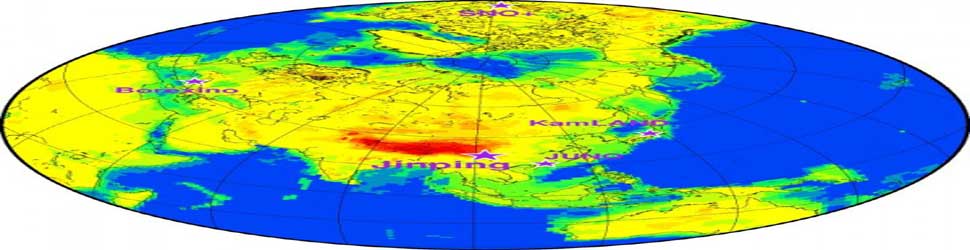
In a new paper, a team of geologists and neutrino physicists boldly claims it will be able to determine by 2025 how much nuclear fuel and radioactive power remain in the Earth's tank. The study, authored by scientists from the University of Maryland, Charles University in Prague and the Chinese Academy of Geological Sciences, was published recently in the journal Nature Scientific Reports.
"I am one of those scientists who has created a compositional model of the Earth and predicted the amount of fuel inside Earth today," said one of the study's authors William McDonough, a professor of geology at the University of Maryland. "We're in a field of guesses. At this point in my career, I don't care if I'm right or wrong, I just want to know the answer."
To calculate the amount of fuel inside Earth by 2025, the researchers will rely on detecting some of the tiniest subatomic particles known to science -- geoneutrinos. These antineutrino particles are byproducts of nuclear reactions within stars (including our sun), supernovae, black holes and human-made nuclear reactors. They also result from radioactive decay processes deep within the Earth.
Detecting antineutrinos requires a huge detector the size of a small office building, housed about a mile underground to shield it from cosmic rays that could yield false positive results. Inside the detector, scientists detect antineutrinos when they crash into a hydrogen atom. The collision produces two characteristic light flashes that unequivocally announce the event. The number of events scientists detect relates directly to the number of atoms of uranium and thorium inside the Earth. And the decay of these elements, along with potassium, fuels the vast majority of the heat in the Earth's interior.
To date, detecting antineutrinos has been painfully slow, with scientists recording only about 16 events per year from the underground detectors KamLAND in Japan and Borexino in Italy. However, researchers predict that three new detectors expected to come online by 2022--the SNO+ detector in Canada and the Jinping and JUNO detectors in China--will add 520 more events per year to the data stream.
"Once we collect three years of antineutrino data from all five detectors, we are confident that we will have developed an accurate fuel gauge for the Earth and be able to calculate the amount of remaining fuel inside Earth," said McDonough.
The new Jinping detector, which will be buried under the slopes of the Himalayas, will be four times bigger than existing detectors. The underground JUNO detector near the coast of southern China will be 20 times bigger than existing detectors.
"Knowing exactly how much radioactive power there is in the Earth will tell us about Earth's consumption rate in the past and its future fuel budget," said McDonough. "By showing how fast the planet has cooled down since its birth, we can estimate how long this fuel will last."
Related Items
India's first hydrogen fuel cell train redefines sustainable rail mobility
Indian scientists helped rewrite a 50-year-old biological rule
Big breakthrough in rare-earth magnetism...