
 Nimish Rustagi / Himanshu Pathak / Apoorva Mahiwal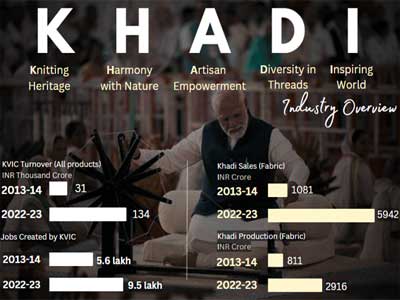
In the last decade, the whole world has seen the revolution that Indian artisans have woven by the 'Charkha' of Khadi. Khadi commands a sentimental value for Indians. It symbolizes the need and importance of indigenous manufactured goods. Today, Khadi means the Fabric of our Nation's Progress and Resilience.
The khadi industry is one of the most prominent traditional industries in India as it not only boosts sales and employment opportunities for the artisans; but also strengthens export potential, contributes to GDP, and promotes rural development and entrepreneurship.
हिंदी में पढ़ें : भारत में सशक्त हो रहे हैं खादी के पारम्परिक उद्योग
Khadi and Village Industries Commission has even exceeded the turnover of the best FMCG companies in India. KVIC has, for the first time, clocked a massive turnover of Rs.1.34 lakh crore in 2022-23. In 2013-14, the turnover of Khadi and Village Industries products was Rs.31,154 crores.
There has been an unprecedented growth of 332% in the sale of indigenous Khadi products made by artisans from 2013-14 to 2022-23. Among the different KVI products, there has been unmatched growth in the production of Khadi fabrics in the last nine years. In 2013-14, the production of Khadi clothes was Rs.811 crore, with a jump of 260%, it has touched the figure of Rs.2916 crore in 2022-23. The demand for Khadi clothes has also increased rapidly from 2013-14 to 2022-23. In 2013-14, its sales were only Rs.1081.04 crore, by 2022-23, it increased by 450% to touch the figure of Rs.5942.93 crore.
Khadi artisans associated with the Khadi sector are also getting the benefit of the increase in the production and sale of Khadi clothes. Their remuneration has been increased by more than 150% since 2013-14. The record production of Khadi has been possible due to the continuous efforts and hard work of the cotton spinners and weavers engaged in the production and sale of Khadi.
Rural revitalization plays an essential role in fulfilling the country’s aim of becoming self-sufficient. In this regard, financial assistance provided through DBT to artisans, modernization of existing infrastructure like charkha and looms, digitization, and development of new technology and designs through R&D activities have increased significantly in the last nine years. This has contributed a lot to the development of Khadi and Village Industries products. To further strengthen the rural economy and to ensure self-sustainability, KVIC unveiled a unique government online platform eKhadiIndia.com in 2021, which showcases over 50,000 products.
Khadi and Village Industries Commission has taken several other initiatives for promoting, developing, and strengthening the rural traditional industries in the country. For instance, KVIC through its Village Industries Program is running skill development training programs to provide training, enhance income, and improve livelihood opportunities in various rural industries like honey and beekeeping, palm jaggery, pottery, handmade paper and leather industry, rural engineering, etc. Apart from this, KVIC is working on a plan to provide sewing machines as well as sewing training to rural women to provide maximum opportunities for women's power in rural areas. Since 2013-14, 7.43 lakh people have been trained across the country and artisans have been provided with need-based tool kits. Further, the appeal of "Vocal for Local" has taken Khadi to new heights of popularity in the country and abroad.
In the last couple of years, KVIC’s main focus has been to create sustainable employment for artisans and unemployed youth. It has set a milestone by creating 9.5 lakh jobs in rural areas in 2022-23, whereas in 2013-14, 5.6 lakh jobs were created. Under the Prime Minister’s Employment Generation Programme, the nation has set a new record by connecting the youth of the country with the Swadeshi Campaign. More than 80% of PMEGP units are set up in rural areas, out of which more than 50% of units are headed by SC, ST, and women entrepreneurs. This has given a boost to women empowerment and women entrepreneurs in the country. Under PMEGP, a total of 73.67 lakh people have been provided employment opportunities by setting up 8.69 lakh new projects during 2022-23, with a total margin money subsidy disbursement of Rs.21870.18 crore from 2008-09 to 2022-23. Further, KVIC, through its training centers and through other promotional schemes, conducts Skill Development Programme and Entrepreneurship Awareness Programmes in the country for unemployed youth to generate self-employment opportunities in traditional industries.
To sum up, the Khadi industry is not just a symbol of India's independence movement and cultural heritage but also an essential driver of economic growth, employment, and sustainable development. By supporting the Khadi industry, the nation has reaped social, economic, and environmental benefits, contributing to the country’s overall progress.
Related Items
An Indian traveller’s eye-opening lessons in the ‘Art of Living’
Are Indian borders just lines on a map!
How the 'Indian Solar Revolution' is transforming rural lives…