
 Brij Khandelwal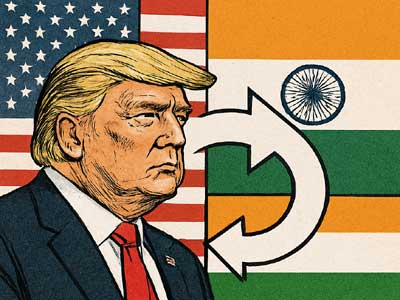
Just when it seemed India-US relations were poised for a rupture, the political weather in Washington turned yet again. President Donald Trump—once quick to hail India as America’s reliable partner—abruptly announced a steep 50 per cent tariff on Indian imports, even going so far as to label India’s economy ‘dead’.
This dramatic move came at a time when India’s deepening ties with Russia and China were already fraying nerves in the corridors of power in the US, prompting fears of an imminent split between the two democracies. And yet, mere hours later, Trump performed a characteristic volte face, describing India-US ties as ‘special’ and dismissing any notion of discord. Is this the end of a trade war, or simply the beginning of a new geopolitical ploy? The world is watching, and the stakes are high.
Read in Hindi: ट्रंप का यू-टर्न और भारत-अमेरिकी रिश्तों की सामरिक वास्तविकता
Dramatic shifts and reversals are not rare in the dance of international diplomacy, where yesterday’s allies can find themselves at odds today. Trump’s brand of ‘U-Turn Politics’ is well-documented, bringing an element of unpredictability to America’s foreign affairs. His September 5th post on ‘Truth Social’—claiming the US had ‘handed India and Russia to China’—sent shockwaves globally.
Yet, before the dust could settle, an official White House statement extolled Indian Prime Minister Narendra Modi as a ‘great leader’, reinforcing the message of an ‘unbreakable’ alliance. Modi’s own response was measured and diplomatic, reiterating the depth and reach of the India-US partnership.
Trump’s initial offensive, followed swiftly by a conciliatory pivot, was not just bluster—it was classic pressure politics. Tariffs and combative rhetoric are meant to rattle, yet Trump understands that isolating India risks weakening US influence in Asia and the Indo-Pacific. With China’s presence looming large, a strong India-US partnership is a more strategic imperative than mere convenience.
Trump’s recall of personal ties—remembering events like Ahmedabad’s ‘Namaste Trump’—served as a timely reminder of the enduring nature of this bilateral relationship. India-US relations are now too resilient to be derailed by short-term disputes or the theatrics of high politics. Their engagement covers a wide spectrum.
Through platforms like the Quad, both nations help to uphold security and balance in the Indo-Pacific, countering growing Chinese assertiveness. Malabar naval exercises, mutual defence procurement, and counterterrorism collaboration have deepened strategic trust, especially critical since the Taliban’s resurgence in Afghanistan. Initiatives such as iCET position India and the US as partners in vital fields like artificial intelligence, semiconductors, and space technology, directly contesting China’s lead. And,
Joint efforts under the ‘US-India Clean Energy Agenda 2030’ highlight shared commitments to sustainability and green growth. This episode highlights the maturity of contemporary India-US relations. Short-lived shocks, tariff flare-ups, or diplomatic provocations are unlikely to unseat a partnership built on mutual strategic necessity. As Prime Minister Narendra Modi noted, this alliance is not just about bilateral advantage; it is a bulwark for democracy and global stability.
Tensions and disagreements do exist within American public debate and policymaking circles. Analysts, former intelligence officials, and allies in Europe, Japan, and Australia express concern over Trump’s unpredictability and its impact on America’s democratic image.
Yet India is quietly expanding its soft power and stature, refusing to be dictated by knee-jerk policies. The real story is this: today, Indian-American relations will be defined by reciprocal strategic interests, not by the flip-flops of political showmanship.
Related Items
Western Media is ‘tough’ on India but ‘soft’ on China!
An Indian traveller’s eye-opening lessons in the ‘Art of Living’
From 'Beacons' to 'Landmarks', India’s changing ‘Lighthouse’ story…