
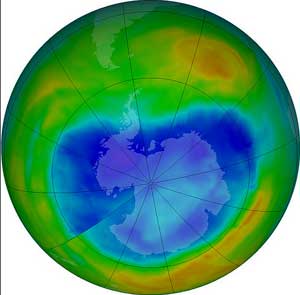
Already in 1987 politicians around the world reached agreement on the Montreal Protocol that bans ozone-depleting substances, in particular chlorofluorocarbons (CFCs). 197 states have now ratified this international treaty. A series of scientific expert reports has since accompanied the efforts to save the ozone layer. The eighth in the series of these reports was published on 10 September 2014 at a joint press conference of WMO (World Meteorological Organization) and UNEP (United Nations Environment Program). As one of the lead authors Empa scientist Stefan Reimann made a major contribution.
Ozone layer returning to its 1980 levels
The Antarctic ozone hole continues to appear every September. But unlike in the 1980s and 1990s it is no longer growing. Since the turn of the millennium it has remained unchanged. There are even signs of a slow recovery. Model calculations reveal that by 2050 the ozone layer may have returned to its 1980 levels. The concentration of most ozone depleting substances (mainly CFCs) mentioned in the Montreal Protocol has fallen as expected. This is monitored in measurements over many years, amongst other things, on Jungfraujoch. The global emissions of HCFCs, introduced as replacements but which are just as harmful to the ozone layer, have stabilized on a high level and are expected to fall in the future.
Now, surprisingly “new” CFCs have been discovered in the atmosphere, which have never been produced on an industrial scale, smaller amounts of which may nonetheless escape as industrial by-products. The concentration of these substances is, however, between 100 and 1,000 times lower than the classic ozone depleting substances. The fact that these substances can be traced shortly after they have been released highlights the capabilities of global measurement networks. The measurement networks act like early warning systems and ensure that emissions of potentially hazardous substances can be identified as early as possible. CFCs used in the past, for instance, in insulating foams and cooling systems still pose a significant threat to the ozone layer, though. During the recycling of these systems, it is important to collect CFCs separately and destroy them by incineration; otherwise this legacy of the past would harm the ozone layer more than all new substances together.
Whereas the classical ozone depleting substances are thus slowly disappearing, the volume of hydrofluorocarbons (HFCs), the replacement for ozone-depleting substances, is increasing by around 7 percent a year. These substances do not harm the ozone layer but they often have a high greenhouse potential and contribute markedly to global warming. They, too, should be replaced in future. There are open questions, too, about the replacement substances supposed to mitigate the greenhouse effect. HFO-1234yf, for example, is intended to be used in AC system of new cars. This substance decomposes in the atmosphere into trifluoroacetic acid – a compound that is not degraded in nature and, therefore, accumulates in the environment.
Worrying deviations discovered
During the regular monitoring of trace gas data from the global measurement networks, the atmospheric researchers noticed significant deviations. These findings are also mentioned in the latest UNEP report. For instance, the concentration of the ozone-depleting gas carbon tetrachloride is not falling by four percent (as predicted) but by only one percent – although production of this substance is only allowed as intermediate, with very small expected emissions. New measurement data indicate that the emissions do not come from Europe or North America.
Related Items
Quality ration at affordable prices to devotees at Maha Kumbh
A few Indian cities, towns have air quality monitoring stations
Toxic ozone is spreading in an unprecedented manner this summer...