
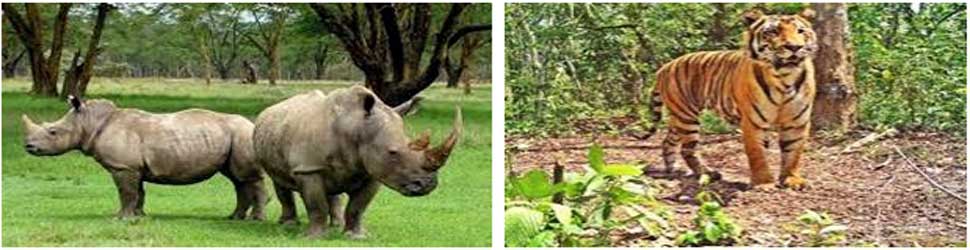
Kaziranga was declared a Game Sanctuary in 1916 and opened to visitors in 1938. It was declared a Wildlife Sanctuary in 1950, and notified as Kaziranga National Park in 1974 under the Wildlife (Protection) Act, 1972, with an area of 429.93 Sq. Km. which has now extended to 899 Sq. Km. subsequently.
Kaziranga National is famous for the Big Five namely the Rhinoceros (2,401 nos), Tiger (116 nos), Elephant (1,165 nos), Asiatic Wild Buffalo and the Eastern Swamp Deer (1,148 nos). It houses the largest population of One Horned Rhinoceros in the world and has about 68% of the entire world population of One-horned Rhinoceros. It also has one of the highest densities of tigers in the wild in the world. It also houses almost entire population of the Eastern Swamp Deer. Besides these big five, Kaziranga supports immense floral and faunal biodiversity. The Kaziranga National Park has on its North the river Brahmaputra, entire stretch of which from Golaghat district boundary on the east to the Kaliabhomora bridge on Brahmaputra in the west. On one hand the annual flood waters of the river bring nourishment, leading to a very high productive biomass, but on the other hand, the phenomenon of erosion takes away lot of valuable and prime habitat.
 Kaziranga National Park has in its vicinity several notified forests and protected areas namely Panbari Reserve Forest and Deopahar Proposed Reserve Forest in Golaghat District, Kukurakata Hill Reserve Forest, Bagser Reserve Forest, Kamakhya Hill Reserve Forest and Deosur Hill Proposed Reserve Forest in Nagaon District, Bhumuraguri Reserve Forest in Sonitpur District, North Karbi Anglong Wildlife Sanctuary in Karbi Anglong district; all these areas are of great ecological importance to the Kaziranga National Park.
Poaching of Rhinoceros in Kaziranga has always been a menace since a long time. But, due to excellent protection measures taken by the Park officials in coordination with local people, there was considerable increase in the population of rhino from a few dozens to the present population of 2401 Rhino. The spurt in rhino poaching in Assam in Kaziranga may be attributed to various factors such as astronomical increase in price of the rhino horns in international market in the last few years, easy escape route via Dimapur-Moreh, availability of illegal fire arms in the region, involvement of various insurgent groups in the rhino poaching and trade, highly porous boundary of the Park etc.
The Kaziranga National Park is an important tourist destination of north eastern region of the country. During the year 2015-16, a total of 1,62,799 tourist, including 11,417 foreign tourists, visited the National Park and ₹4.19 crore revenue was earned from entry fees.
Anti poaching Interventions
Park authorities have taken all efforts to contain poaching within the available means by rigorous patrolling and extensive field duties. Despite all odds such as lack of infrastructure, equipment, shortage of staff, a very porous border all along, a very hostile terrain, every attempt has been made to contain poaching. Following major initiatives have been taken by Government:
• The Kaziranga National park was declared a Tiger Reserve in the year 2007 and since then it is getting sufficient financial support under “CSS Project Tiger” which is under the National Tiger Conservation Authority (NTCA), Govt. of India. During the year 2016-17, the Authority sanctioned ₹1662.144 lakh (Central share- ₹1495.03 lakh).
• An electronic surveillance system, called the Electronic Eye has been installed in Kaziranga from the fund provided by the NTCA under “Project Tiger”. Under the scheme, seven tall towers have been erected at different locations, fitted with visual and thermal imaging cameras with 24x7 real time video access from the control room.
• The State Government of Assam has brought about policy and legislative changes, bringing Wildlife (Protection) (Assam Amendment) Act, 2009 for strict enforcement in handling wildlife crime including poaching of Rhinos. The penalty for the offence committed under Wildlife (Protection) Act has been raised to minimum seven years and fine not less than fifty thousand rupees.
• In the year 2010 the Government conferred the power to use arms by forest officials and immunity to forest staff in use of fire-arms under Section 197 (2) of the CrPC, 1973.
• Additional support for control of poaching in Kaziranga National Park has been provided by placing 423 numbers of the Assam Forest Protection Force personnel and 125 home guards. Process is on to acquire more sophisticated arms for the frontline staff.
• Kaziranga Biodiversity and Development Committee was constituted with members from other concerned departments of the State Government and technical experts to examine the infrastructural development in holistic manner for better conservation in the fringe area of the Kaziranga National Park.
(Author is a Member of Indian Forests Service and presently serving as Director, Kaziranga National Park & Field Director, Kaziranga Tiger Reserve, Bokakhat, Assam.)
Related Items
Song that echoed across South India, but never became ‘National Song’
How a 'Master Communicator' turns ideas into National Missions…
Supreme Court calls rivers a national asset; Orders action to save rivers