
 Samiksha Bharti News Service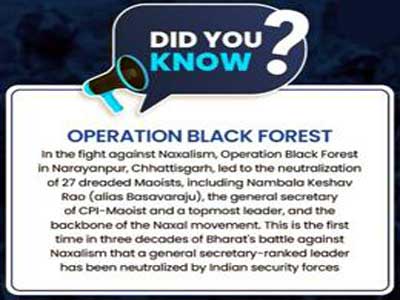
Naxalism in the country was spread across the ‘Red Corridor’, impacting states such as Chhattisgarh, Jharkhand, Odisha, Maharashtra, Kerala, West Bengal, Madhya Pradesh, and parts of Andhra Pradesh and Telangana. India’s multidimensional counter-LWE strategy has sharply reduced violence, weakened the movement, and reintegrated districts.
Reflecting the central government's decisive defence strategy against Left Wing Extremism, significant progress has been made in reducing Naxal-affected regions across the country. With decisive interventions, the Naxal-most-affected districts have been brought down from 36 of the year 2014 to only three in 2025, and total LWE-affected districts from 126 to just 11 by 2025.
Read in Hindi: 'लाल गलियारे' से नक्सल-मुक्त होने की ओर भारत...
The Government has adopted a unified, multi-dimensional and decisive strategy. Operating on the clear principles of dialogue → security → coordination, the Government has set the firm target of making every Naxal-affected area completely Naxal-free by March 2026.
In 2025 so far, 317 Naxals have been neutralised, 862 arrested, and 1,973 surrendered. In 2024 alone, 290 were neutralised, 1,090 arrested, and 881 surrendered. A total of 28 top Naxal leaders have been neutralised, including one Central Committee Member in 2024 and five in 2025. Major successes include 27 hardcore Naxals killed in Operation Black Forest, 24 surrendering in Bijapur on 23 May, and 258 surrendering in October this year across Chhattisgarh (197) and Maharashtra (61), including 10 senior Naxals in the surrenderers.
Only three districts remain, which are most affected by Naxalism in 2025 compared to 36 in 2014. The total Naxal-affected districts has been reduced from 126 in 2014 to just 11 in 2025. Fortified police stations increased from only 66 in 2014 to 586 constructed in the last 10 years. Police stations recording Naxal incidents dropped sharply from 330 across 76 districts in 2013 to merely 52 in 22 districts by June 2025. Additionally, 361 new security camps have been established in the last six years, and 68 night-landing helipads have been built to strengthen operational reach.
The Central Government has effectively choked Naxal financing by forming a dedicated vertical in the NIA that seized assets worth over ₹40 crore, while states seized more than ₹40 crore, and the Enforcement Directorate attached ₹12 crore. Simultaneous action has inflicted severe moral and psychological damage on urban Naxals and tightened control over their information warfare networks.
The government has strengthened the capacity of Left-Wing Extremism-affected states through increased financial support and targeted assistance under key security and infrastructure schemes.
The government released ₹3,331 crore under the Security Related Expenditure scheme to LWE-affected states in the last 11 years, marking a 155 per cent increase in fund release over the last 10 years.
Under the Special Infrastructure Scheme, the Central Government approved ₹371 crore for strengthening State Special Forces and Special Intelligence Branches, ₹620 crore for 246 Fortified Police Stations in the original phase. The scheme extended till 2026, and in the extended period, ₹610 crore for further enhancement of SF, SIB and district police, along with ₹140 crore for 56 additional FPS.
In the last eight years, projects worth ₹1,757 crore have been approved, and so far, ₹445 crore has already been released by the Central Government. A total of 586 Fortified Police Stations have been constructed since 2014. ₹3,817.59 crore provided under the Special Central Assistance Scheme.
Under the Assistance to Central Agencies Scheme, ₹125.53 crore has been released for camp infrastructure in the last 10 years and ₹12.56 crore for the upgradation and establishment of hospitals.
The Government has significantly strengthened infrastructure in Left Wing Extremism–affected areas by expanding road networks and mobile connectivity to enhance accessibility, security response, and socio-economic integration.
From May 2014 to August this year, the government has constructed 12,000 km of roads in Left Wing Extremism-affected regions, while projects for a total of 17,589 km have been approved at a cost of ₹20,815 crore, ensuring all-weather connectivity and mobility in previously inaccessible areas.
In the first phase, 2,343 (2G) mobile towers were installed at a cost of ₹4,080 crore. The second phase sanctioned 2,542 towers with an investment of ₹2,210 crore, of which 1,154 are already installed.
Additionally, under the Aspirational Districts and 4G Saturation schemes, 8,527 (4G) towers have been approved, with 2,596 and 2,761 towers, respectively, now functional, dramatically improving communication and intelligence reach in core Naxal zones.
The government has ensured deep financial inclusion in LWE-affected districts by establishing 1,804 bank branches, 1,321 ATMs and 37,850 banking correspondents. It also opened 5,899 post offices across 90 districts with coverage at every five km, bringing banking, postal and remittance services directly to remote communities previously under Naxal influence.
The government has launched skill development initiatives in 48 LWE-affected districts by sanctioning 48 Industrial Training Institutes with an investment of ₹495 crore and approving 61 Skill Development Centres. Of these, 46 ITIs and 49 SDCs are already functional, providing vocational training and employment opportunities to local youth, thereby reducing Naxal recruitment and integrating remote communities into the mainstream economy.
The National Investigation Agency established a dedicated anti-Naxal vertical that investigated 108 cases and filed charge sheets in 87 cases, significantly weakening the Maoist organisational structure through accelerated prosecution.
Simultaneously, in 2018, the government raised the Bastariya Battalion comprising 1,143 recruits, including an initial 400 local youths from the worst-affected districts of Bijapur, Sukma and Dantewada in Chhattisgarh, turning former Naxal strongholds into sources of trained security personnel fighting the insurgency.
Security forces, through decisive operations such as Octopus, Double Bull and Chakbandha, have liberated long-held Naxal bastions, including Budha Pahad, Parasnath, Baramasia and Chakrabandha in Bihar after three decades of Maoist control, established permanent camps deep inside remote jungles, and reached the hitherto impenetrable Abujhmad in the Chhattisgarh region. These sustained offensives forced the PLGA battalion to abandon its core area in Bijapur-Sukma and caused the complete failure of the Naxalites’ 2024 Tactical Counter Offensive Campaign, marking the collapse of their strategic stronghold and operational dominance.
The government’s surrender-cum-rehabilitation policy has accelerated the collapse of Naxal cadres by offering attractive incentives and assured livelihood. High-rank LWE cadres receive ₹5 lakh, middle/lower-rank cadres ₹2.5 lakh, and all surrenderers get a ₹10,000 monthly stipend for professional training lasting 36 months.
As a result, 521 LWE cadres surrendered this year alone, with the total rising to 1,053 after the new state government assumed power, successfully bringing hundreds of former insurgents into the mainstream with guaranteed employment and security.
Over the past eleven years, the government’s coordinated, multi-pronged strategy-combining calibrated security operations, unprecedented infrastructure push, financial choking, rapid development saturation, and an attractive surrender policy, has shrunk Left-Wing Extremism from 126 districts in 2014 to just 11 in 2025, with only three remaining “most-affected”.
Violence has fallen by over 70 per cent, civilian and security-force casualties have plummeted, top Maoist leadership has been systematically neutralised, and thousands of cadres have chosen mainstream life over armed struggle. While pockets of resistance remain and complete eradication demands sustained vigilance till the declared deadline of 31 March 2026, the trajectory is unmistakable: the ideological and territorial backbone of the Naxal insurgency has been broken, paving the way for lasting peace and development in regions long deprived of both.
Related Items
Western Media is ‘tough’ on India but ‘soft’ on China!
From 'Beacons' to 'Landmarks', India’s changing ‘Lighthouse’ story…
“Only five minutes…” has shaken France and forced India to think…