
 Brij Khandelwal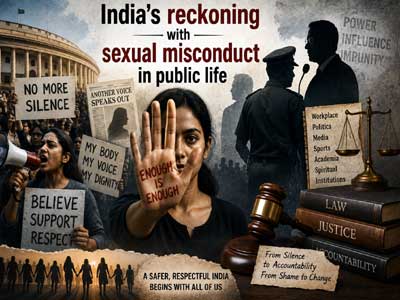
How many times must a woman speak before the system listens? How many headlines must scream before a powerful man is made to answer for an alleged sexual crime?
Across India, the scene is familiar. A Netaji faces allegations. The media erupts. Activists march. Hashtags trend. Survivors are urged to speak, prove, repeat and relive trauma. Then the machinery of law begins its long journey, moving at a pace that can drain courage, money, evidence and hope.
Read in Hindi: सार्वजनिक जीवन में यौन आरोपों और जवाबदेही की लंबी कहानी
Witnesses grow weary. Public attention shifts. Political loyalties intervene. Yesterday’s outrage becomes tomorrow’s forgotten story. Why does justice so often demand endurance from victims while power appears to possess time, influence and escape routes, asks activist Padmini Iyer.
Public commentator Paras Nath Choudhary observes, "Over two decades India has watched a recurring drama on its political stage, film sets, newsrooms and religious institutions: a powerful man, a set of allegations, a media storm, and sometimes years later, a verdict. Outcomes have ranged from life imprisonment to acquittal, quiet resignation to open denial. Together these cases form a national conversation about power, impunity and what accountability looks like when the accused sits near the top of a hierarchy."
Prajwal Revanna, once a JD(S) Member of Parliament and grandson of former Prime Minister HD Deve Gowda, became the centre of one of the most explosive recent scandals. In April 2024, pen drives containing hundreds of sexually explicit videos allegedly showing him assaulting multiple women circulated in his Hassan constituency just before Lok Sabha polling. He fled the country, was arrested on return in May 2024, and was chargesheeted in four cases.
In August 2025, a special court convicted him of repeatedly raping a domestic worker at his family’s farmhouse, relying on video evidence, DNA analysis and forensic material, and sentenced him to imprisonment for the remainder of his natural life. He is appealing; the Karnataka High Court has so far declined to suspend the sentence.
Kuldeep Singh Sengar, a former BJP MLA from Unnao, Uttar Pradesh, was convicted in the rape of a minor girl. The case became a national flashpoint amid allegations that his associates orchestrated the death of the survivor’s father in custody and a car crash that killed several of her family members and her lawyer. He received a life sentence. In late 2025, the Delhi High Court suspended that sentence; in May 2026, the Supreme Court set aside the suspension and remitted the matter, directing the High Court to decide the main appeal expeditiously. Sengar remains incarcerated on a related sentence.
Brij Bhushan Sharan Singh, a sitting BJP MP and until 2023 president of the Wrestling Federation of India, faced sexual-harassment complaints from several top women wrestlers, including Olympic medallists. Their public protests at Jantar Mantar drew nationwide attention to allegations that had gone unaddressed for years. FIRs were registered; he denied the charges. In August 2026, a Delhi court acquitted him and a co-accused, describing the allegations as not proved beyond reasonable doubt and, in parts of the order, as appearing politically motivated. Complainants have indicated they will appeal.
Mahipal Maderna, a former Rajasthan cabinet minister, became entangled in the 2011 disappearance and alleged murder of Bhanwari Devi, an auxiliary nurse-midwife. He acknowledged an affair but denied involvement in her death. The scandal ended his political career. The long-running trial has seen most accused granted bail on grounds of delay; Maderna himself died in 2021 while the case remained pending.
Two of India’s most prominent self-styled spiritual leaders were convicted in cases involving their followers. Asaram Bapu was convicted of raping a minor at his ashram and sentenced to life imprisonment. In May 2026, the Rajasthan High Court upheld the life term for rape while setting aside certain other charges; the Supreme Court has issued notice on his appeal and declined interim suspension of sentence. Gurmeet Ram Rahim Singh, head of the Dera Sacha Sauda, was convicted in 2017 on two counts of rape and is serving a 20-year sentence. He has been granted repeated paroles and was recently acquitted by the Punjab and Haryana High Court in a journalist-murder case; that acquittal is under challenge in the Supreme Court.
India’s #MeToo movement launched in 2018, propelled in part by actress Tanushree Dutta’s public account of harassment by veteran actor Nana Patekar on a 2009 film set, an allegation he has denied. Accusations also surfaced against actor Alok Nath by television producer Vinta Nanda, dating to the 1990s; an FIR was filed, and Nath has denied the charges.
The wave reached government and media. MJ Akbar, then a Union Minister of State for External Affairs, faced harassment allegations from more than a dozen women journalists. He resigned and pursued a criminal defamation case against journalist Priya Ramani, which he lost in 2021 when a Delhi court ruled in her favour.
Perhaps the most legally consequential #MeToo-era case took the longest to resolve. Tarun Tejpal, founder and former editor-in-chief of Tehelka, was accused of sexually assaulting a young colleague in a hotel lift during the magazine’s 2013 ThinkFest in Goa. A trial court acquitted him in 2021 in a judgment widely criticised for its characterisation of the survivor’s post-assault behaviour. The Goa government appealed.
On 6 August, nearly thirteen years after the original complaint, the Bombay High Court’s Goa Bench overturned the acquittal, convicted Tejpal of rape and related offences, and sentenced him to ten years’ rigorous imprisonment plus a substantial fine payable to the survivor. Tejpal has indicated he will challenge the verdict in the Supreme Court.
Not every episode involved allegations of assault. Some were scandals of exposure and denial: ND Tiwari’s 2009 sex-video controversy and later DNA confirmation of an extramarital son; Abhishek Manu Singhvi’s 2012 video scandal, which courts restricted from further circulation.
Older episodes, Swami Nithyananda’s video scandal, actor Shiney Ahuja’s rape conviction, the 1970s political sex-photo controversy involving Suresh Ram, show that the phenomenon is not new; only that documentation, discussion and occasional prosecution have grown more thorough with each decade.
Looking across these cases, several patterns stand out. The gap between allegation and legal resolution is often enormous; Tejpal’s case took thirteen years to reach High Court conviction; others involve years of appeals. Outcomes vary sharply according to whether the survivor had institutional or media backing when allegations surfaced and according to the political weight the accused carried.
Several of the most consequential matters involved victims structurally dependent on the alleged abuser: domestic staff, minors, or athletes under federation authority.
Precision matters. Some cases ended in convictions delivered or upheld by higher courts. Others remain allegations that were denied and, in several instances, never tested to a final adverse verdict, or ended in acquittal. For the latest status of any pending matter, court records and current reporting remain the most reliable sources; several of these matters are still under appeal.
Social activist Mukta Gupta says, "Every figure listed as accused or convicted is male. The women appear as accusers, survivors or victims: Tanushree Dutta and Priya Ramani, Vinta Nanda, Bhanwari Devi, and the unnamed survivors in the Revanna, Sengar, Asaram, Ram Rahim and Tejpal cases. This is not unique to India. High-profile sexual-misconduct cases involving public figures tend to feature male accused across most countries’ media coverage, partly reflecting who holds concentrated institutional power, political office, film-industry seniority, and religious authority, where patterns of alleged abuse more often arise. Female public figures in Indian public life face their own scandals, but those more often centre on financial corruption, nepotism or personal-life controversies rather than sexual-assault allegations in which they stand as the accused."
The cases keep arriving. The courts keep grinding. Survivors keep waiting. The question remains unanswered: how many times must a woman speak before the system truly listens?
Related Items
'Chicken Curry', 'Salt' and 'Anger' turning kitchens into crime scenes
'Chitthi Aayi Hai...', a song that made millions long for home...
India’s Curious Double Life; Clouds, Computers and the Sacred Fire…