
The findings could have implications for keeping manmade structures – such as sensors, robots and unmanned aerial vehicles – free from pollutants, pollen and dirt. The review study is published in the Journal of Experimental Biology.
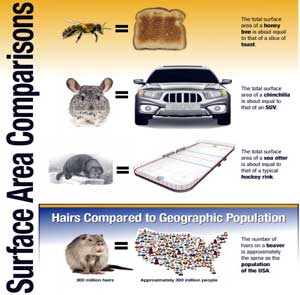
The research team focused on the many ways hair allows animals to both get dirty and remain dirt-free. The researchers found that a honeybee has the same amount of hairs as a squirrel: 3 million. That is nothing compared to butterflies and moths – each have nearly 10 billion hairs. The human head, as a comparison, has just 100,000.
“Animals likely evolved with hair in order to stay warm. But it also brings a burden,” said David Hu, a Georgia Tech associate professor who co-led the study. “More hair means more surface area that can trap dirt, dust and pollen.”
Hu and his mechanical engineering Ph.D. student, Guillermo Amador, ran calculations to find the true surface area of animals, or the surface area that includes every location where dirt can be collected. The hairier it is, the larger the creature’s true surface area. In fact, the team says it’s 100 times greater than its skin surface area.
“A honeybee’s true surface area is the size of a piece of toast,” said Hu. “A cat’s is the size of a ping pong table. A sea otter has as much area as a professional hockey rink.”
And with all that surface area comes the challenge of keeping away all the dirt. It turns out that animals use a variety of ways to stay clean. Some depend on non-renewable strategies and use their own energy.
“Dogs shake water off their backs, just like a washing machine,” said Amador, who recently graduated. “Bees use bristled appendages to brush pollen off their eyes and bodies. Fruit flies use hairs on their head and thorax to catapult dust off of them at accelerations of up to 500 times Earth’s gravity.”
Other animals and insects use more efficient, renewable cleaning tactics.
“They don’t do anything extra to stay clean. It just happens,” said Amador.
Eyelashes, for example, protect mammals by minimizing airflow and funneling particles away from eyes. Cicadas have sharp points on their wings that act as pincushions, essentially popping airborne bacteria like water balloons.
It’s these renewable cleaning tactics that have the Georgia Tech team thinking about applications for technology.
“Understanding how biological systems, like eyelashes, prevent soiling by interacting with the environment can help inspire low-energy solutions for keeping sensitive equipment free from dust and dirt,” said Hu. “Drones and other autonomous rovers, including our machines on Mars, are susceptible to failure because of the accumulation of airborne particles.”
Related Items
Rival firms make the best partners when developing new technology
Agra, where the streets belong to the animals…
Comfort meets technology in India’s Vande Bharat Sleeper revolution