
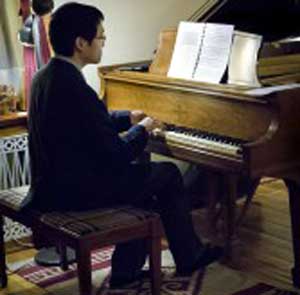
Composers found new ways of fusing the two musical qualities late last century, said Cheung, assistant professor in music at the University of Chicago.
“Through technology and thinking about acoustics, we can change sounds on the computer in innumerable ways,” said Cheung, whose musical composition earned him a 2012 Rome Prize from the American Academy in Rome.
The work of Cheung and others shows the power of mathematics to open new possibilities in music. Modern experiments with computer music are just the most recent example. According to musician-scholars like Eugenia Cheng, a visiting senior lecturer in mathematics and a concert pianist, the history and practice of music would have unfolded much differently without an appreciation of what unites music and math.
During the Baroque period, a mathematical breakthrough inspired one of Cheng’s favorite composers, Johann Sebastian Bach, to write The Well-Tempered Clavier (1722), his book of preludes and fugues in all 24 major and minor keys.
Bach was able to write in every key so successfully because mathematicians found better ways to calculate the 12th root of two (see video). This is related to the musical problem of dividing the octave into 12 equal intervals, which involves splitting sound waves into ratios rather than equal lengths.
“That’s why music before the Baroque time didn’t really modulate,” Cheng said. “It always stayed in the same key. Because of the way that they tuned keyboards, if they moved a key it would have sounded terrible.”
Cheng spent 2004 to 2006 as an LE Dickson Instructor at UChicago and returned as a visiting lecturer in 2013 to 2014. Her home institution now is the University of Sheffield, where she has been tenured since 2006.
Expanding an audience for math
As an educator, Cheng is adept at relating just about anything to mathematics, including food. She developed a series of YouTube lectures on the mathematics of food [LINK], covering topics such as “The perfect puff pastry,” “The perfect Mobius bagel,” and “The perfect way to share a cake.” The series evolved into a book, How to Bake Pi, which will be published by Profile Books in March 2015. She also has brought mathematics to a wider audience through works such as the mathematics of cream tea, the mathematics of pizza, and mathematics and Lego.
As a mathematician, Cheng specializes in category theory, which she characterizes as “the mathematics of mathematics.”
“Mathematics is a process of abstraction, where you study something without the details that aren’t really central to it at that particular instant,” she said.
Mathematical techniques entail extracting problems from science or life and asking if they contain common elements that can be studied apart from their real-life contexts.
“Category theory was only really needed when mathematics reached a certain state of complexity, and that was in about the ‘40s and ‘50s,” Cheng said. That’s when the field was pioneered by UChicago’s Saunders Mac Lane and Columbia University’s Samuel Eilenberg.
Mathematics of musical composition
Cheung is a composer and musician who readily describes how an understanding of mathematics often can lead to a deeper appreciate of certain musical compositions.
In graduate school Cheung studied with Tristan Murail, now a professor emeritus of music at Columbia University, who pioneered thoughts about how harmony and timbre could come together. Cheung cites Jonathan Harvey’s Mortuos Plango, Vivos Voco (1980), as a classic early example of doing this electronically. In this work, Harvey used spectral analysis and re-synthesis on a computer to morph the sounds of the tenor bell at Winchester Cathedral into the sound of a singing boy, his son.
“Murail is very much a groundbreaking composer in his own right with this movement called spectral music, which like all music that concerns itself with harmony is related to mathematics,” Cheung said. Composers of spectral music mathematically analyze sound spectra, observe how they behave and how they’re related, which provides the basis for transforming their harmony and timbre.
Murail, for example, is fascinated by bell sounds. “Tristan has had very precise tools to measure these sonorities,” Cheung said. “He might use a recording — for example, of Mongolian overtone chanting — and then actually plug it into the computer to see what’s there. From there he might re-orchestrate a passage for instrumental ensemble.”
Cheung also morphs one sound into another in his own work.
“I do this mostly intuitively, I have to say, and without the aid of software when I’m writing purely for acoustic instruments,” he said. “But I’m also familiar with some of the technology that allows you to look at sounds on the computer. It’s certainly changed the way I think about sound, even when I’m not using any program.”
He does, however, conduct experiments in crossing timbres, as do other composers. When, for example, can the sounds of a piano and a violin completely fuse?
“They’re such different instruments. One is sustained and vibrated. The other is attacked and decayed,” Cheung noted. “And yet we can somehow put them together in this grey area where they might be able to sound ambiguous with one another.
“With these technological and mathematical tools, we are able to have control of both precision and ambiguity. Knowing about acoustics and timbre can lead us to the re-synthesis of sounds we already know, and to tuning with a fine-tooth comb. But then combining these sounds or altering them in ambiguous ways can lead to exciting discoveries, making us listen in unfamiliar ways. That’s what I’m interested in from a creative standpoint.”
Related Items
No evidence of Liver or Kidney Injury with Ashwagandha Root Extract
A tiny computer's big role in unveiling Universe's earliest whispers
Agra Gharana, the vanishing heritage of classical music