
That is among the conclusions of a review of nearly 200 scientific studies relevant to the topic. The review was scheduled for online publication this week in the journal Biological Conservation by Çağan Şekercioğlu (pronounced Cha-awn Shay-care-gee-oh-loo), an assistant professor of biology at the University of Utah.
There are roughly 10,000 bird species worldwide. About 87 percent spend at least some time in the tropics, but if migratory birds are excluded, about 6,100 bird species live only in the tropics, Şekercioğlu says.
He points out that already, “12.5 percent of the world’s 10,000 bird species are threatened with extinction” – listed as vulnerable, endangered or critically endangered by the International Union for Conservation of Nature.
Research indicates about 100 to 2,500 land bird species may go extinct due to climate change, depending on the severity of global warming and habitat loss due to development, and on the ability of birds to find new homes as rising temperatures push them poleward or to higher elevations. The most likely number of land bird extinctions, without additional conservation efforts, is 600 to 900 by the year 2100, Şekercioğlu says.
“Birds are perfect canaries in the coal mine – it’s hard to avoid that metaphor – for showing the effects of global change on the world’s ecosystems and the people who depend on those ecosystems,” he adds.
Şekercioğlu reviewed the scientific literature relevant to climate change and tropical birds with Richard Primack, a biologist at Boston University, and Janice Wormworth, a freelance science writer and ecological consultant in Australia.
Putting the Heat on Tropical Birds
Scientists expect climate change to bring not only continued warming, but larger and-or more frequent extreme weather events such as droughts, heat waves, fires, cold spells and “once-in-a-century” storms and hurricanes. Birds may withstand an increase in temperature, yet extreme weather may wreck habitats or make foraging impossible.
“The balance of evidence points to increases in the numbers of intense tropical hurricanes (though hurricane frequency could decrease overall),” Şekercioğlu and colleagues write. “This would predominantly affect tropical bird communities, especially species living in coastal and island habitats.”
Şekercioğlu says it is difficult to predict how habitat loss, emerging diseases, invasive species, hunting and pollution will combine with climate change to threaten tropical birds, although “in some cases habitat loss [from agriculture and development] can increase bird extinctions caused by climate change by nearly 50 percent.”
In addition, “compared to temperate species that often experience a wide range of temperature on a yearly basis, tropical species, especially those limited to tropical forests with stable climates, are less likely to keep up with rapid climate change.”
The researchers say studies indicate:
-- Climate change already has caused some low-elevation birds to shift their ranges, either poleward or to higher elevations, causing problems for other species.
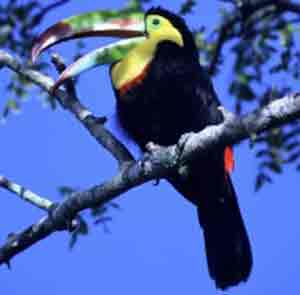
Global warming helped rainbow-billed toucans move from Costa Rican lowlands to higher-elevation cloud forests, where they now compete for tree-cavity nest space with the resplendent quetzal. The toucans also eat quetzal eggs and nestlings.
-- Birds with slower metabolisms often live in cooler tropical environments with relatively little temperature variation. They can withstand a narrower range of temperature and are more vulnerable to climate change.
-- Climate change may spread malaria-bearing mosquitoes to higher elevations in places like Hawaii, where the malaria parasite can threaten previously unexposed birds.
-- Longer and less regular dry seasons and droughts expected during global warming may reduce populations of tropical birds that often time their breeding with wet seasons when food is abundant.
Şekercioğlu acknowledges that “not all effects of climate change are negative, and changes in temperature and precipitation regimes will benefit some species.
… Nevertheless, climate change will not benefit many species.”
Scenarios for Extinction
A 2008 study by Şekercioğlu and late climatologist Stephen Schneider calculated 60 scenarios of how tropical land bird extinction rates will be affected by various possible combinations of three variables: climate change, habitat loss and how easily birds can shift their range, meaning move to new habitat. Citing those estimates, the new review paper says that “depending on the amount of habitat loss, each degree of surface warming can lead to approximately 100 to 500 additional bird extinctions.”
The Intergovernmental Panel on Climate Change has predicted 1.1 to 6.4 degrees Celsius (2 to 11.5 degrees Fahrenheit) of global warming of the Earth’s surface by the year 2100, which Şekercioğlu’s study converted into a best case of about 100 land bird extinctions and a worst case of 2,500.
He says the most likely case now is considered to be 3.5 C (6.3 F) warming by 2100, resulting in about 600 to 900 land bird species going extinct. These estimates are conservative because they exclude water birds, which are 14 percent of all bird species.
Because they don’t travel far, “sedentary” birds “are five times more likely to go extinct in the 21st century than are long-distance migratory birds,” says Şekercioğlu.
The review found:
--Tropical mountain birds are among the most vulnerable to climate change. Warmer temperatures at lower elevations force them to higher elevations where there is less or no habitat, so some highland species may go extinct.
--Climate change and accompanying sea-level rise pose problems for birds in tropical coastal and island ecosystems, “which are disappearing at a rapid rate,” Şekercioğlu and colleagues write. Many such ecosystems already have been invaded by non-native species and exploited by humans.
-- Birds in extensive lowland forests with few mountains – areas such as the Amazon and Congo basins – may have trouble relocating far or high enough to survive.
-- Tropical birds in open habitats such as savanna, grasslands, scrub and desert face shifting and shrinkage of their habitats.
-- Rising sea levels will threaten aquatic birds such as waders, ducks and geese, yet they often are hemmed in by cities and farms with no place to go for new habitat.
-- Tropical birds in arid zones are assumed to be resilient to hot, dry conditions, yet climate change may test their resilience by drying out oases on which they depend.
Related Items
Wealthy protect themselves from climate risks, leaving poor vulnerable
Biodiversity loss could trigger sovereign debt crises
Collective action and behaviour change transforming rural sanitation