
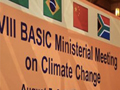
The meeting emphasized once again that it was time for the developed world to work in close cooperation with the four BASIC countries to resolve the issues pertaining to climate change. It said that the rich nations must in fact take a lead in dealing with pollution- induced climate change and take suitable action keeping in mind the ‘historical responsibilities ’. The Indian environment minister Mr.Prakash Javadekar said later that it was found that on the mitigation front actions taken by the developing countries are more concrete than the developed world. It is therefore high time for the developed countries to “walk the Talk” in this regard. (Read in Hindi: जलवायु परिवर्तन के मुद्दों पर अधिक ध्यान देने की आवश्यकता)
The Vice-Chairman of the National Development and Reform Commission of China Xie Zhenhua pointed out that developing countries were contributing 60% cut in the mitigation field by cutting down Green House Gas emissions. This has become possible thanks to the big strides taken in renewable energy sector in India and many other countries.
It is unfortunate that despite the dangers of global warming in front of us not much is being done. What we see is a tussle between the developed and the developing world on taking most wanted measures.
For instance, the Kyoto Protocol which forms the central point of all efforts in the field of environment and subsequent negotiations have put a responsibility on developed nations to provide sufficient financial, technical and capacity building support to the developing countries to enable them to pursue mitigation efforts. This has not happened. The joint statement issued later expressed disappointment over the continued lack of any clear roadmap for providing US$ 100 billion per year by developed countries by 2020. They urged developed countries to honour their obligations to provide ‘new, additional and predictable financial support to developing countries in a measurable, reportable and verifiable manner’.
It was in this backdrop that the New Delhi meeting of BASIC countries called upon the developed countries to make early and substantial capitalization of the Green Climate Fund (GCF). It also underlined the need for all parties to communicate their intended nationally determined contributions (INDCs) as early as possible.
Climate change has also been identified as the biggest health threat of this century. This must make the world sit up and resolve issues at the earliest. Urgent steps need to be taken to meet this challenge.
Obviously, most of the brunt of the implications of climate change is borne by the developing countries. But that is no reason for the developed countries to take a back seat. Since climate change impacts are global in nature, adaptation measures also need an international response.
Fortunately, this bloc of four countries has become quite powerful to be able to thwart any attempt by rich nations to unreasonably impose their wish on developing nations during any negotiations on climate change issues under the UN convention.
The joint statement issued after the two- day meeting reaffirmed their position that the future global climate deal must fulfil the principles of equity and 'common but differentiated responsibilities' (CBDR) under UN convention.
The Ministers reiterated that the six core elements for the 2015 outcome at Lima have been identified and that these should be addressed in a ‘balanced and comprehensive manner through an open and transparent, inclusive, party-driven and consensus-building process’.
It was noted with concern that the pre-2020 ambition gaps exist not only in mitigation but also in adaptation, finance, technology and capacity-building support to developing countries. They reiterated that the contribution of developing countries to mitigation efforts is far greater than that of developed countries and could be further enhanced if developed countries effectively implement and significantly increase their commitments of providing finance, technology and capacity building support to developing countries.
The Ministers called for the full operationalization of and close coordination between institutions established in the Bali process, including the Green Climate Fund, the Standing Committee on Finance, the Technology Executive Committee, the Climate Technology Centre and Network and the Adaptation Committee.
One hopes that the next round of UN Climate summit meeting later this month will be more productive keeping in view the concerns of the developing nations.
The next round of the BASIC ministerial meeting will take place in South Africa in October.
(Author is a Senior Freelance Journalist)
Related Items
Wealthy protect themselves from climate risks, leaving poor vulnerable
Collective action and behaviour change transforming rural sanitation
When bombs fall on the ground, the climate bleeds…