
 Brij Khandelwal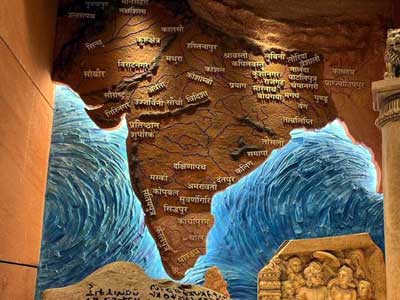
Once soaring like an eagle, India today finds itself caged within shrunken borders. This is the same civilisation that once ruled from Kandahar to Burma, from Tibet to Sri Lanka, whose influence touched Java and Sumatra.
And yet, in the twenty-first century, fragments of its land lie in foreign hands—Pakistan sits on Kashmir, China gnaws at our Himalayan frontiers, and Delhi pleads its case in the dusty corridors of the United Nations. Is this the destiny of a nation that once set the rhythm of Asia? Has ‘Akhand Bharat’, i.e. Undivided India, been reduced to nothing more than a slogan or a decorative map?
Read in Hindi: कब पूरा होगा अखंड भारत का अद्भुत सपना...!
India was never meant to be confined to the narrowness of present-day borders. The very soul of this land has always breathed expansion, vision, and grandeur. But the colonial scalpel carved our geography into fragments, and post-independence leaders, blinded by compromise, accepted humiliation as fate.
Each passing decade has shrunk India’s influence—Nepal slips into China’s orbit, Sri Lanka defies us, and the Maldives plays with external powers. Tibet, once our cultural frontier, is now a Red Army outpost. And the ungrateful Bangladesh is posturing as a hostile rival. What will remain tomorrow if we do not act today?
History speaks with clarity. Nations that shrink are forgotten; nations that expand are feared and respected. The Mauryan Empire wrote its glory in expansion. The British, Russians, and Americans built their power not by retreat but by conquest. Israel, small in size but vast in ambition, redefined its borders through war and willpower. Expansion is not an option—it is the lifeblood of lasting nations.
India today has the numbers, the economy, the military, and the vision. What it lacks is courage. Shackled by an image of passive non-violence, we have forgotten that peace is sustained only by those powerful enough to enforce it. A nation that does not instil fear is itself condemned to live in fear.
What if the youth of India were told that their destiny is not to merely chase jobs and pensions, but to restore the grandeur of a nation that once made empires tremble? Would not their blood ignite with purpose? Would not this nation rise again, roaring like the lion it once was?
This is not just a political question—it is a psychological one. A defeatist mindset, a culture of compromise, and timid diplomacy have weakened our self-belief. It is time to break these chains. India must not simply seek friendship—it must command respect, even fear. The Maldives must remain firmly in Delhi’s orbit. Nepal must operate under India’s protective umbrella. In Sri Lanka, no move should be possible without India’s sanction. Azad Kashmir must be reclaimed from Pakistan; China’s land-grab must be reversed without hesitation.
Words will not return Katchatheevu Island from Sri Lanka—force will. Nor can we ignore the vulnerability of Indian Tamils in Jaffna or the millions of Indians in the Gulf—India must secure their safety with a strong presence, even in Dubai, which should be forced to allow military presence. Like Idi Amin of Uganda, someday a moody Sheikh could order the expulsion of Indians.
The world respects only power, never equality. And power is measured not in economic graphs or cultural festivals but in territory, muscle, and resolve. If Russia can redraw maps in Europe, if America can dictate terms across oceans, why must India, with its civilizational depth and unmatched youth power, hesitate?
The dream of Akhand Bharat must cease to be a dream—it must become a national mission. India must once again soar as the eagle it was destined to be, reclaiming lost skies, lost pride, and lost lands. This is not merely the politics of today; it is the destiny of our century. The time of waiting is over. The era of compromise must end. Akhand Bharat will rise—not as an idea, but as a reality.
Related Items
“Only five minutes…” has shaken France and forced India to think…
India building its semiconductor future…
India’s foray into the world of silicon…