
 Brij Khandelwal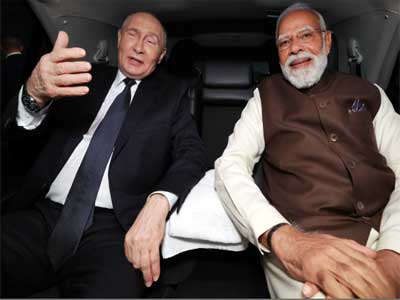
Delhi’s brutal winter suddenly felt a degree warmer as Vladimir Putin’s aircraft touched down and the capital basked in the diplomatic glow of a ‘Putin Yatra’. The Russian leader’s 2025 visit did more than thaw the December chill; it reignited one of the world’s most durable partnerships and signalled India’s return to the global centre stage with striking self-assurance.
The visit marks more than a ceremonial exchange. It captures the Bharatiya Janata Party’s evolving foreign policy—an assertive, multipolar vision that blends hard realism with a pragmatic nod to the Nehruvian idea of strategic autonomy. Once seen as rigidly pro-Western and free-market in ethos, India’s current posture now extends a confident hand to Moscow, West Asia, and Africa. It even engages in a guarded dialogue with Beijing. Congress labels it a “confused course correction,” but critics miss the point: this isn’t confusion, it’s convergence, where ideology yields to national interest, and economics shapes diplomacy.
Read in Hindi: मोदी–पुतिन की ‘हम साथ–साथ’ यात्रा पर ट्रंप पूछ रहे, ‘ये रिश्ता क्या कहलाता है?’
The subtext is hard to miss. In an age of Western volatility and tariff tantrums, New Delhi is turning its gaze eastward and northward, building newer routes to prosperity untethered from the mood swings of Washington.
If optics were euphoric, the outcomes were significant. The joint statement released after Putin’s meeting with Prime Minister Narendra Modi reads like a blueprint of renewed strategic alignment. From defence and nuclear collaboration to Arctic navigation, trade settlement, and travel liberalisation, the summit packed in both ambition and actionable deliverables.
Among the highlights was Moscow’s offer of next-generation small modular nuclear reactors, a compact, scalable technology capable of rapidly boosting India’s clean energy output. For a power-hungry economy balancing climate goals and industrial expansion, SMRs hold transformative promise: safer design, localised deployment, and stable energy for future growth corridors.
Energy-dominated discussions. Putin reaffirmed Russia’s role as India’s most reliable energy partner, pledging uninterrupted oil, gas, and coal supplies “even in the worst of crises.” The contrast with the uncertainties of Western markets could not have been starker.
Equally important was the quiet advance toward de-dollarisation. By expanding settlement in national currencies and reviving talks on a free-trade pact with the Eurasian Economic Union, both sides are nudging global trade patterns away from dollar dependence. A Russian pharma plant using Indian biotech, a new mobility framework, and 30-day fee-free e-visas for Russian tourists added a welcome human touch to the strategic bonhomie. Moscow’s decision to train Indian seafarers for emerging Arctic trade routes underscores a shared eye on the future—where melting ice opens new corridors of connectivity.
Putin’s warm praise of Modi, “India is fortunate to have a leader who does not bow to pressure”, struck a chord at a time when Indo-US relations face turbulence over technology curbs, tariffs, and Washington’s discontent with India’s flourishing Russian oil imports.
The renewed energy of the India–Russia bond draws on a deep reservoir of history. From the steel plants and MiG fighters of mid-20th-century industrialisation to the landmark 1971 Treaty of Peace, Friendship and Cooperation, Moscow has been integral to India’s modern rise. Even after the Soviet collapse, the partnership endured, anchored in defence, space, and now, critical energy links.
Today, Russia remains India’s top defence supplier and is pivotal in nuclear cooperation. But beyond legacy, both nations are adapting the partnership to a fragmented global order. For New Delhi, Moscow provides both strategic depth and the flexibility to hedge against Western inconsistency.
Beijing’s reaction, seasoned with strategic restraint, is likely to be pragmatic rather than anxious. Chinese analysts know Russia’s ties with India run deeper than its recent alignment with Beijing. In fact, Moscow’s quiet influence over both the “dragon” and the “elephant” may help stabilise Asia’s volatile geometry. China will watch for any anti-Beijing tilt, but mostly rely on Moscow’s balancing instincts to preserve regional equilibrium.
Washington, on the other hand, will view the optics with unease. Already irked by India’s discounted Russian energy imports and independent UN voting pattern, the US establishment is likely to read the Putin–Modi camaraderie as a veiled rejection of America’s Indo-Pacific calculus. Yet New Delhi’s position is clearer than ever: Russia is indispensable—for defence, for energy stability, and as a counterbalance in an increasingly unpredictable world order. Strategic autonomy, not alignment, remains the guiding principle.
Perhaps the most consequential outcome of the visit lies in the nuclear sector. Russia’s willingness to co-develop SMRs could redefine India’s clean energy transition. These factory-built reactors, deployable within a few years, promise multiple dividends: reduced coal dependency, safer localised power generation, green hydrogen support, and lower long-term import costs. In a world fretting over energy insecurity, the Indo-Russian energy compact offers rare predictability.
Putin’s Yatra was more than a bilateral event—it was a declaration. Amid sanctions, supply disruptions, and the West’s inward turn, India and Russia reaffirmed the value of constancy. Their partnership has survived empires, ideological shifts, and global realignments not by nostalgia, but by continual adaptation.
As Washington hardens its rhetoric and Europe retreats into post-industrial caution, Delhi and Moscow have chosen movement over stasis, engagement over estrangement. The symbolism is powerful: even in a divided world, some partnerships not only endure, but they also evolve.
In the end, as drifts of frost blanket Delhi, the Kremlin’s warmth lingers, a reminder that realpolitik need not always feel cold.
And for India, with dismal tidings drifting in from Uncle Sam’s land, Moscow’s embrace has brought a much-needed ray of strategic sunshine.
Related Items
Western Media is ‘tough’ on India but ‘soft’ on China!
From 'Beacons' to 'Landmarks', India’s changing ‘Lighthouse’ story…
Diplomatic significance of Pezeshkian’s meeting with Mirwaiz