
 Brij Khandelwal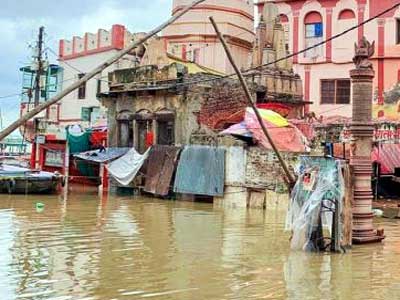
The devastation unleashed by relentless rains in northern India has once again drowned entire regions, from the historic Taj Mahal in Agra to the sacred soil of Mathura-Vrindavan.
The Yamuna River surged over its banks, submerging homes, farmlands, and monuments. But this is not just a natural disaster; it is a disaster fashioned by human greed and negligence. Callous urban planning, reckless construction, encroachment by builder lobbies, and tampering with the river’s course have obstructed its natural flow. Now, the river has answered with fury, serving a chilling reminder: nature has its limits, and we have crossed them.
This year’s deluge revived memories of the catastrophic floods of 1978. Some damage was averted thanks to the desilting of Delhi’s Okhla Barrage, increased storage at the Gokul Barrage, built in 1997, and diversions from the Hathnikund Barrage into canal systems.
Because of these stopgap measures, Agra escaped the worst. Yet, the 2025 monsoon drowned states across northern India. Torrential rains battered Punjab, Haryana, Uttarakhand, Uttar Pradesh, and Delhi. Swollen rivers — the Yamuna, Sutlej, and Beas — engulfed farms and cities alike. More than 90 lives have been lost, thousands displaced; Punjab alone accounted for 43 deaths, in what is being called its worst flood in decades.
Delhi was a helpless spectator as the Yamuna crossed danger levels. Neighbourhoods turned into lakes, and the Taj Mahal found floodwaters lapping against its boundary walls after fifty long years. This was not merely ‘nature’s play’. It was the ugly consequence of thoughtless development, rampant encroachments, and the widening threat of climate change. Indeed, old wisdom reminds us: rivers never forget their ancient courses.
The core lesson is plain. Land greed is sinking us. By colonising floodplains and wetlands, we have disrupted nature’s safety valves. In Delhi, uncontrolled construction on riverbanks left no room for the Yamuna to breathe, so it spilt into residential colonies.
Gurugram, once hailed as the ‘Millennium City’, has turned into a nightmare. Its explosive and unplanned urbanisation clogged lakes and drains. Encroachment on Ghata Lake and Najafgarh Drain has ensured that even a brief spell of rain turns streets into rivers. This year, the disaster became exponentially worse.
Rajasthan witnessed extreme rainfall that revived dry rivers and lakes. The Surwal Dam in Sawai Madhopur burst, washing away villages but also recharging groundwater. In Ajmer, Bundi, and Udaipur, seasonal rivers came alive again. With 63 per cent excess rainfall, the state recorded 193 deaths, reminding us that nature is simply correcting what humans destroyed through reckless water exploitation.
In Agra, floods revealed another ignored crisis — the silt-choked Yamuna. Its riverbed lies buried under filth, drastically reducing flow capacity. Lack of desilting has amplified pressure on embankments. In Uttarakhand, cloudbursts unleashed landslides, burying houses and roads. Low-lying settlements along the Ganga in Uttar Pradesh remained waterlogged for weeks — drainage choked not by nature, but by encroachments and neglect.
The 2025 floods also shattered a popular myth: that global warming means less rain. The real threat is erratic rainfall patterns — cloudbursts, sudden deluges, and severe storms. Climate change is no longer a prediction; it is a daily reality.
What India’s cities need is not more chaotic sprawls like Gurugram, but hydrology-based planning. Wetlands must be restored, no-construction zones enforced in floodplains, and green belts created to soak excess water. Punjab and Haryana must move to sustainable farming models. Uttarakhand must invest in reliable early-warning systems. Above all, governments must shed their complacency. Relief delayed and accountability dodged will not work. Climate-adaptive policies, strict enforcement of environmental laws, and citizen participation are urgently required.
The rivers, in their fury, are our teachers — warning us against arrogance, neglect, and land greed. If we fail yet again to heed their message, the next flood will not just be merciless; it will be catastrophic.
Related Items
Western Media is ‘tough’ on India but ‘soft’ on China!
An Indian traveller’s eye-opening lessons in the ‘Art of Living’
From 'Beacons' to 'Landmarks', India’s changing ‘Lighthouse’ story…